Computational Speckle Pattern Interferometry
Dense sensing of extremely small vibrations over a wide field of view
1Carnegie Mellon University 2University of Toronto
CVPR 2026
Awarded "Best Demo"
TL;DR, we propose computational speckle pattern interferometry (CSPI), a single-shot method to recover dense per-pixel micro-scale displacement and motion from speckle interferograms—without manual phase stepping or precision phase-shifting hardware.
Lightly tapping on a tuning fork creates tiny surface displacements on the prongs, but often far too small to see directly. CSPI recovers this motion densely across the surface, showing not just that the object vibrates, but also how much each pixel moves.
Here, the camera captures a raw speckle interferogram (above) — a noisy pattern that encodes displacement in its intensity variations. CSPI decodes this into a dense per-pixel displacement map (below) from single-shot, with no phase stepping or precision hardware.
Hue = wrapped displacement
saturation = phasor magnitude
lightness = intensity.
Dense full-field recovery of tiny vibrations
Many mechanical and acoustic signals are encoded in surface motions that are too small to observe directly, including structural resonances, sound-induced vibrations, and other subtle deformations.
Existing approaches typically impose a trade-off between these two goals. Some methods offer high sensitivity but measure motion only at sparse locations. Others provide broader spatial coverage, but require scanning, multiple phase-stepped measurements, or carefully controlled optical hardware in order to recover quantitative displacement.
Our method, Computational Speckle Pattern Interferometry (CSPI), replaces the traditional phase-stepping approach with a computational formulation, while maintaining the ability to measure dense motion over a large field of view. After calibration, CSPI recovers dense per-pixel displacement and motion from a single speckle interferogram, without precision phase-shifting hardware or controlled phase stepping during measurement.
Optical configuration
In the in-plane arrangement used for our main experiments, CSPI illuminates the object with two mutually coherent laser beams from different directions. After scattering from the surface, the fields interfere at the camera, producing a speckle interferogram whose intensity depends on tiny surface displacement.
How the coherent signal forms
The speckle may look random, but it encodes optical phase. When the target moves laterally, its optical path length changes before any visible image-space motion occurs.
Interference converts this hidden phase shift into measurable intensity changes, which CSPI uses to recover displacement-driven phase change.
What dense, tiny-motion sensing lets us see
Quantitative validation: known motion on a translation stage
With the translation-stage setup introduced above: we command the target to move 20 µm laterally, pause, and then move 20 µm back. From each frame, CSPI recovers a phasor whose angle encodes displacements over time, while its magnitude captures information about motion during the camera exposure.
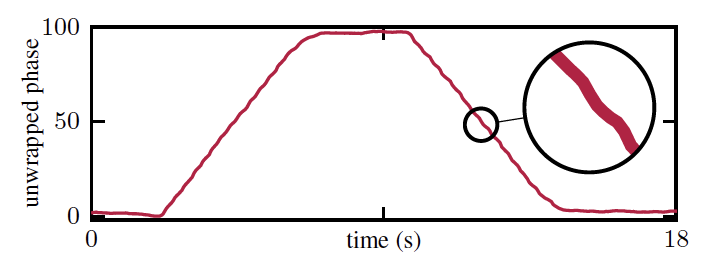
Unwrapped phase
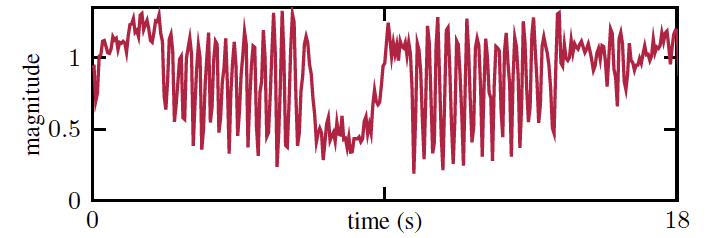
Phasor magnitude
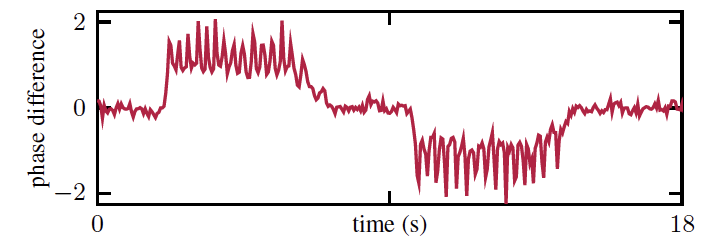
Phase difference
Dense mode-shape recovery on resonant objects
Chladni plates are a classic way to visualize resonant mode shapes: when the plate is driven at different frequencies, nodal lines appear where the surface remains nearly still.
Here, a contact speaker drives a Chladni plate at different frequencies. Instead of using sand that collects along nodal lines, CSPI directly recovers the surface deformation densely across the plate, making the frequency-dependent nodal structure visible over the full field of view.
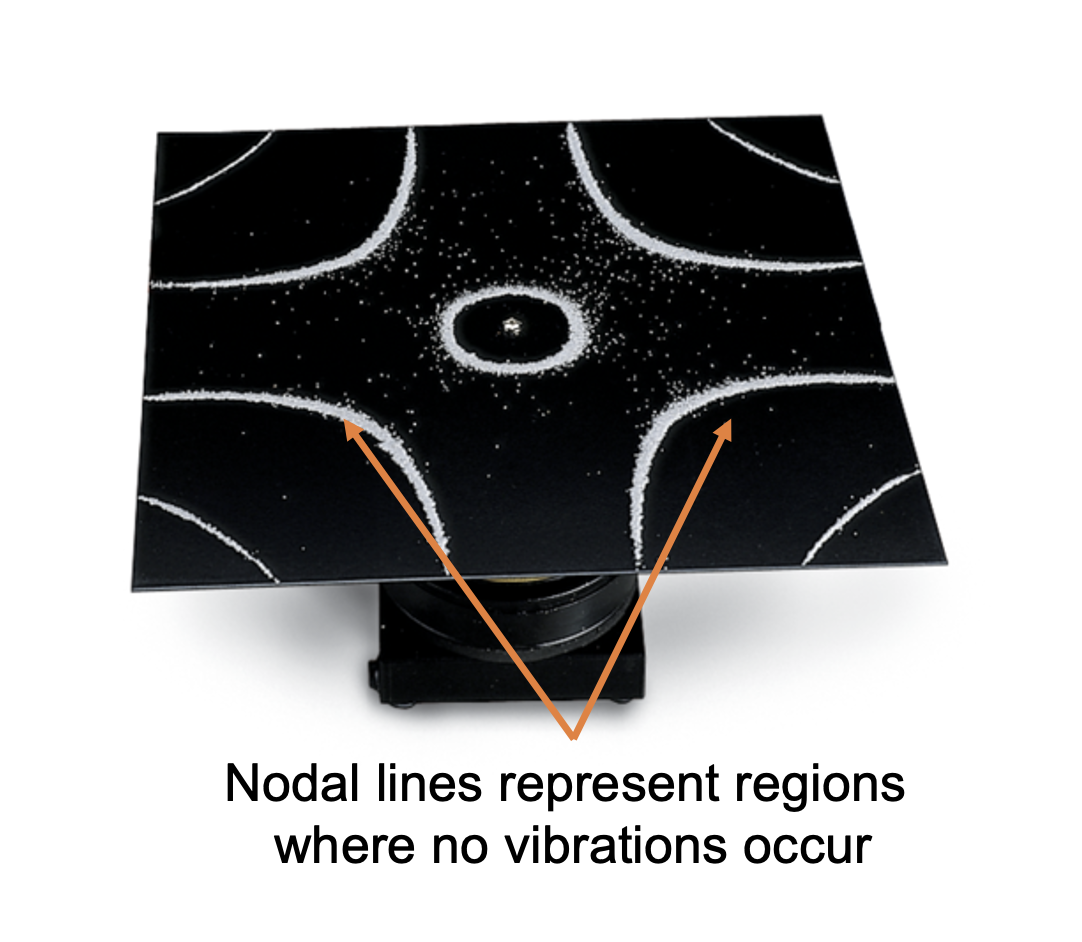
Chladni plate setup
Chladni plate at 134 Hz
Chladni plate at 150 Hz
Indirect audio from tiny surface vibrations
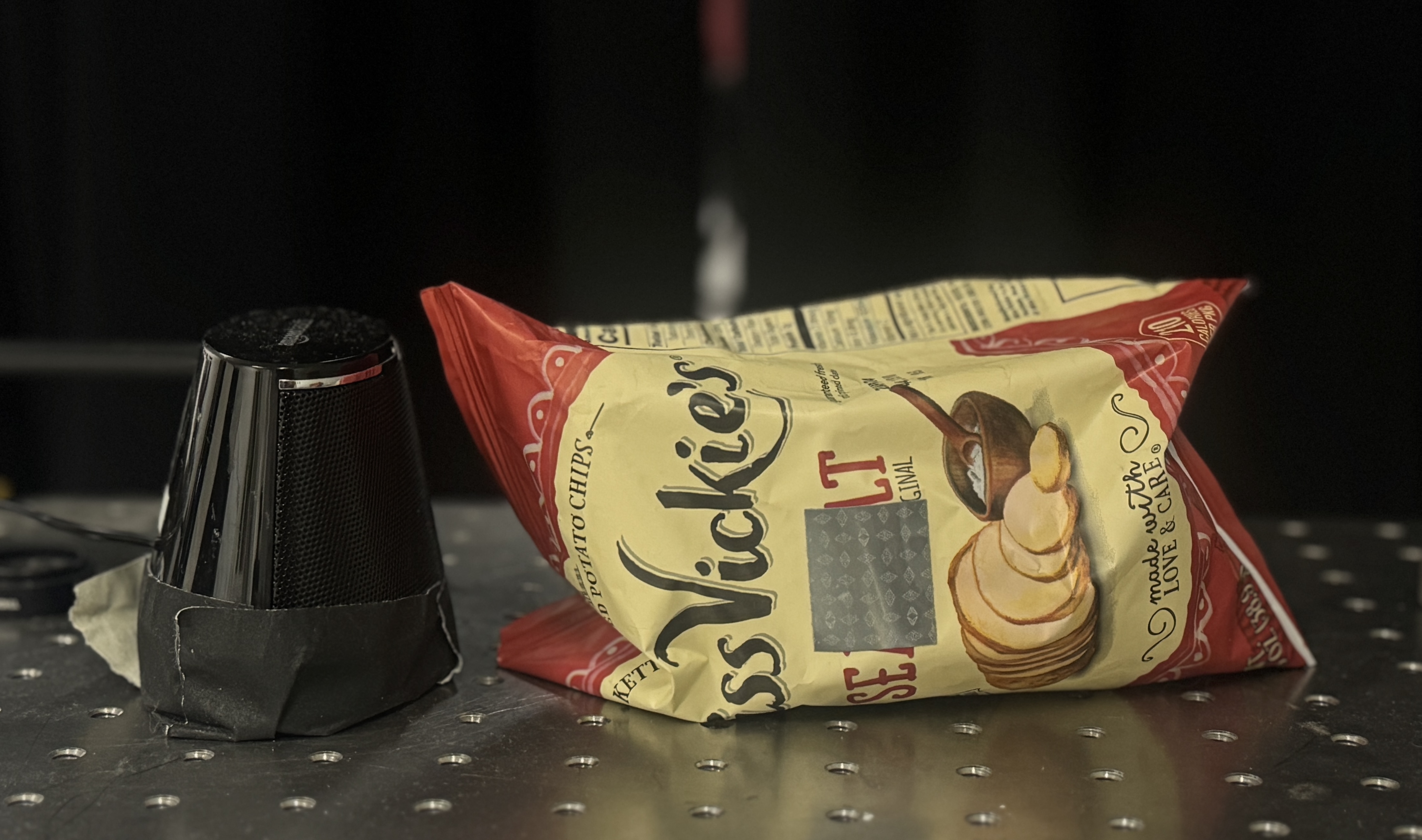
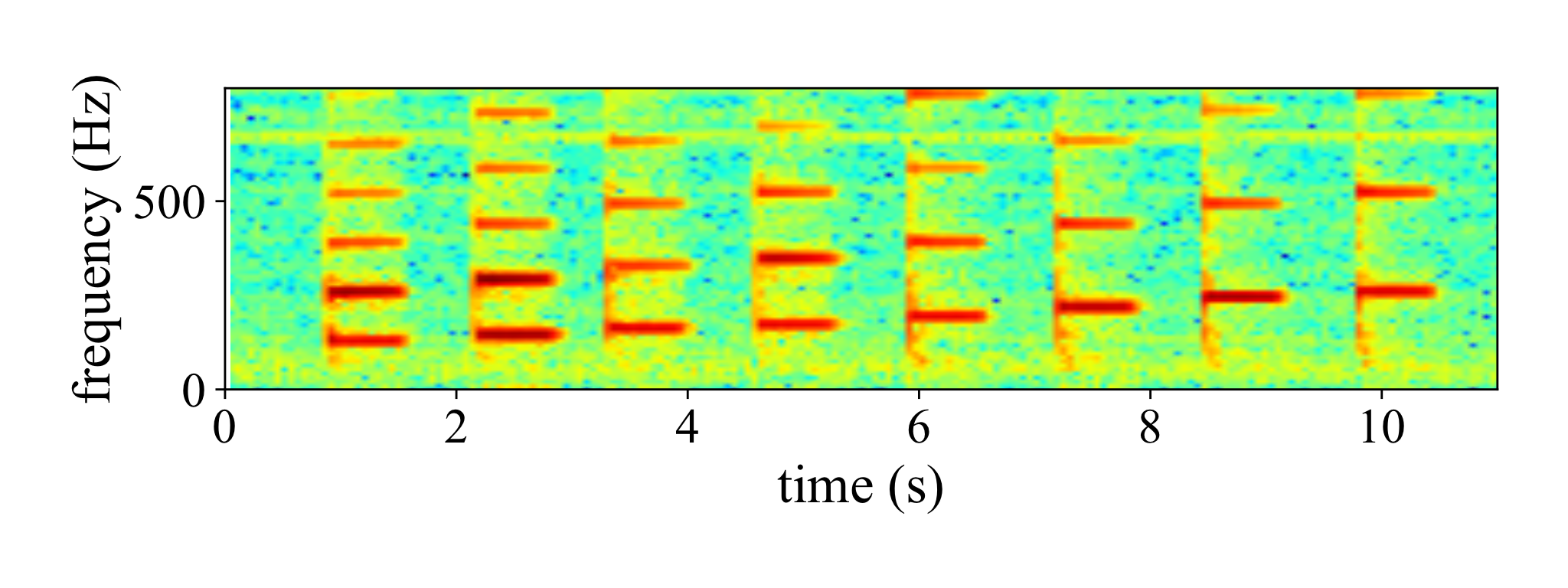
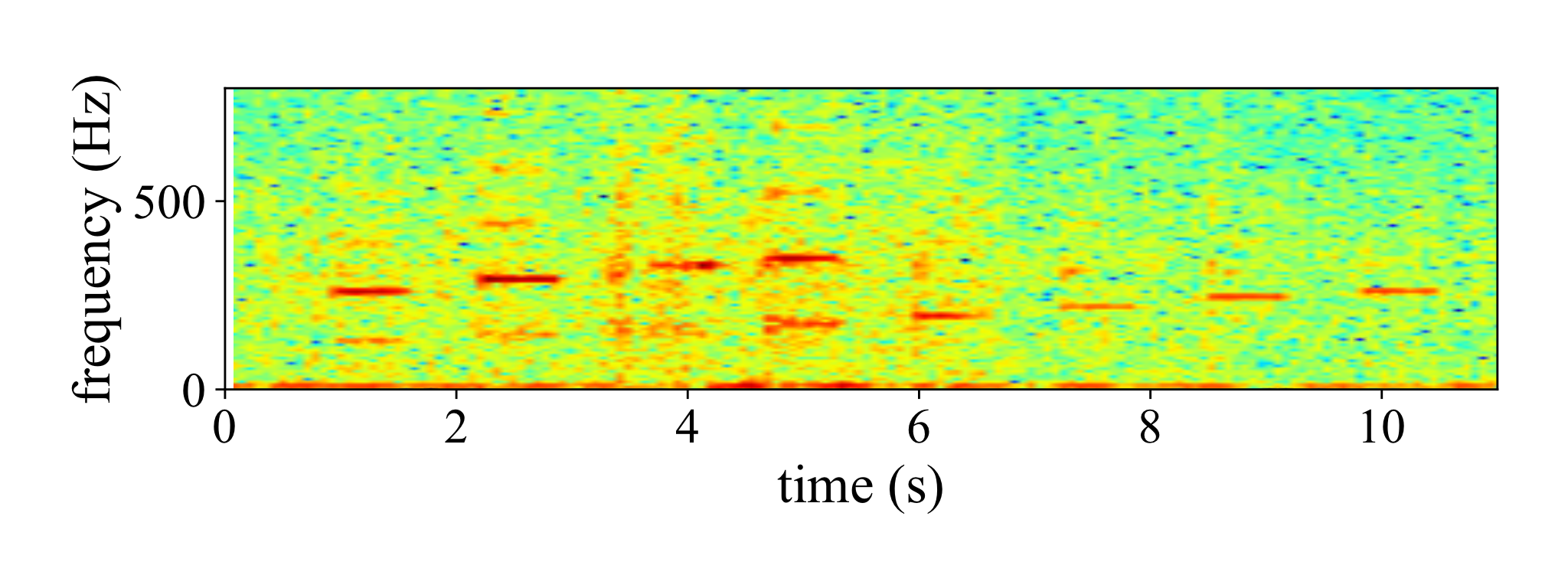
Sound waves can induce extremely small vibrations on nearby objects. In this experiment, a speaker plays piano notes from C3 to C4 toward a chip bag, causing the bag surface to vibrate in response. The recovered spectrogram closely follows the microphone recording and preserves higher-order harmonic structure.
Chip bag setup
Ground-truth spectrogram
Ground-truth audio
CSPI in-plane spectrogram
CSPI reconstructed audio
BibTeX
@inproceedings{wu2026cspi,
  title     = {Computational Speckle Pattern Interferometry},
  author    = {Wu, Shengxi and Yang, Sophia and Chan, Dorian and O'Toole, Matthew},
  booktitle = {Proceedings of the IEEE/CVF Conference on Computer Vision and Pattern Recognition (CVPR)},
  year      = {2026}
}
Acknowledgements
This work was supported by a NSF CAREER award (IIS 2238485) and a NSF-BSF award (IIS 2513219).