
Abstract
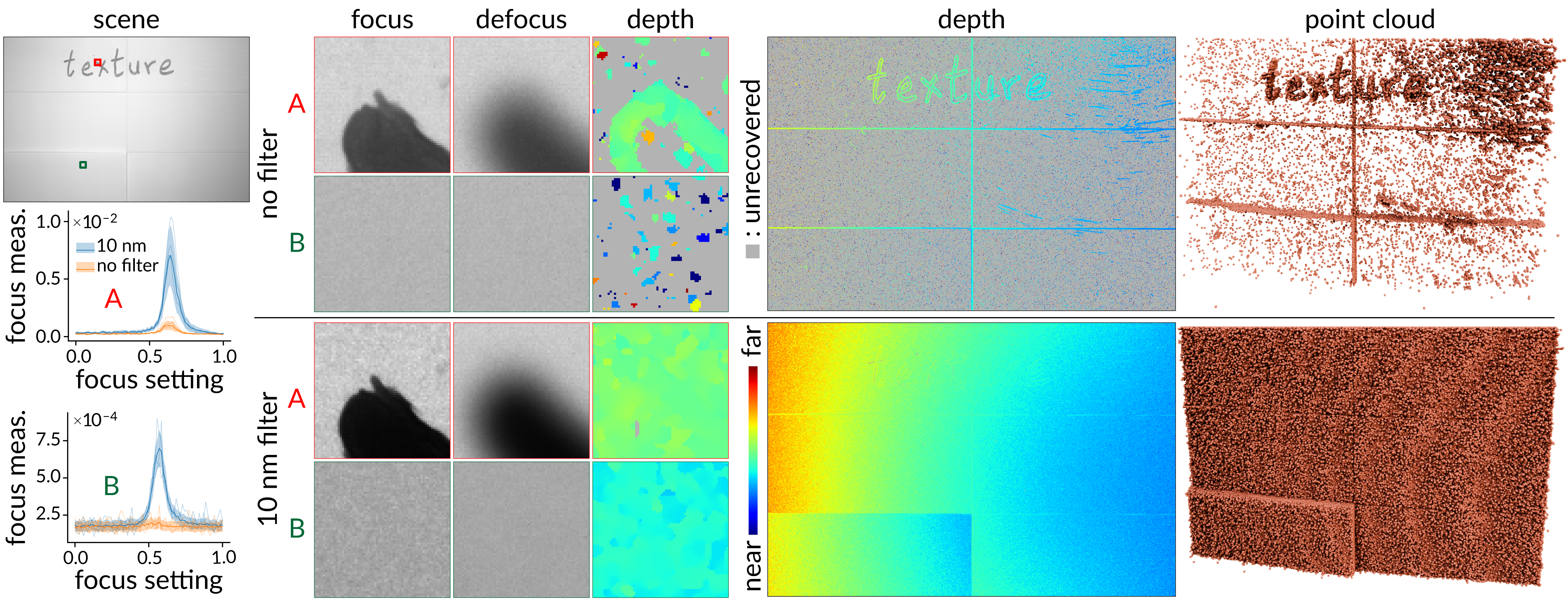
We present a theory of textured appearance of optically rough surfaces based on wave optics, emphasizing the role of texture for passive depth from focus. Our theory shows that even surfaces that traditional computer vision would consider textureless can produce textured appearance, due to subjective speckle from surface microgeometry. We analyze the properties of this second-order texture, and show that we can enhance its contrast under natural ambient lighting by simply using a narrowband spectral filter. Doing so results in dramatic improvements in passive depth reconstruction of seemingly textureless scenes, as we demonstrate through extensive theory, simulations, and real-world experiments.
Video
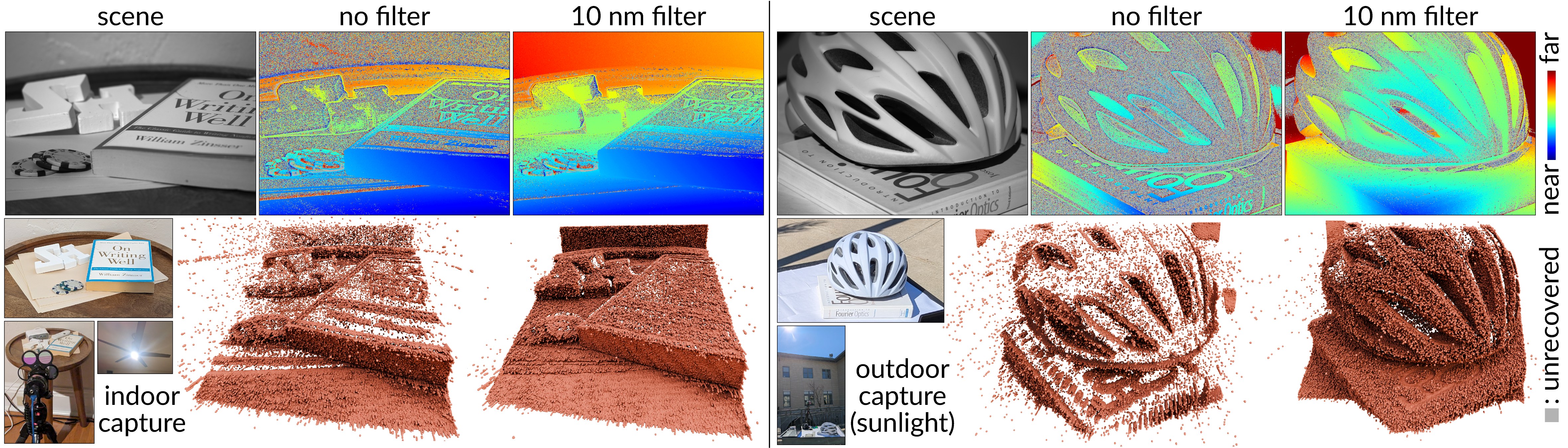
Robustness to illumination conditions
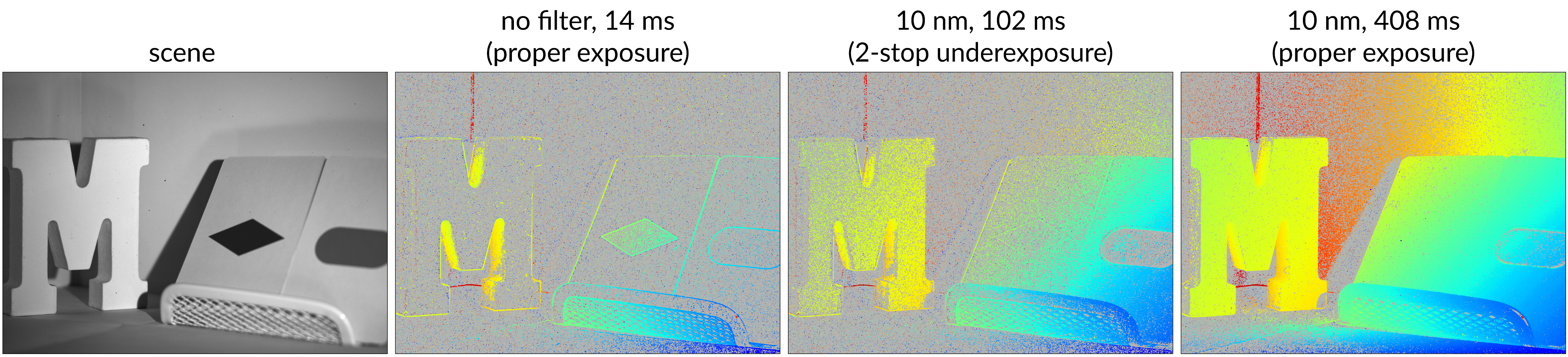
Robustness to underexposure conditions
Visualization
Visualizations of all our experimental results are available at the interactive supplemental website.
Resources
Paper: Our paper and supplement are available on arXiv and locally.
Poster: Our poster is available here.
Presentation: Our presentation slides are available in PDF and Keynote format.
Code: Our code will be available soon.
Data: Our data will be available soon.
Citation
@InProceedings{Ranganathan:SOT:2026,
	author    = {Ranganathan, Sreekar and Gkioulekas, Ioannis},
	title     = {A second-order theory of texture for depth from focus},
	booktitle = {European Conference on Computer Vision (ECCV)},
	year      = {2026},
	pages     = {1--10},
	publisher = {Springer},
}
Acknowledgments
We thank Dorian Chan, Aswin Sankaranarayanan, Matthew O'Toole, and Anat Levin for helpful discussions about speckle, and Mian Wei for feedback on writing. This work was supported by NSF award 2047341, and a Sloan Research Fellowship.